The Equation Series
Menu
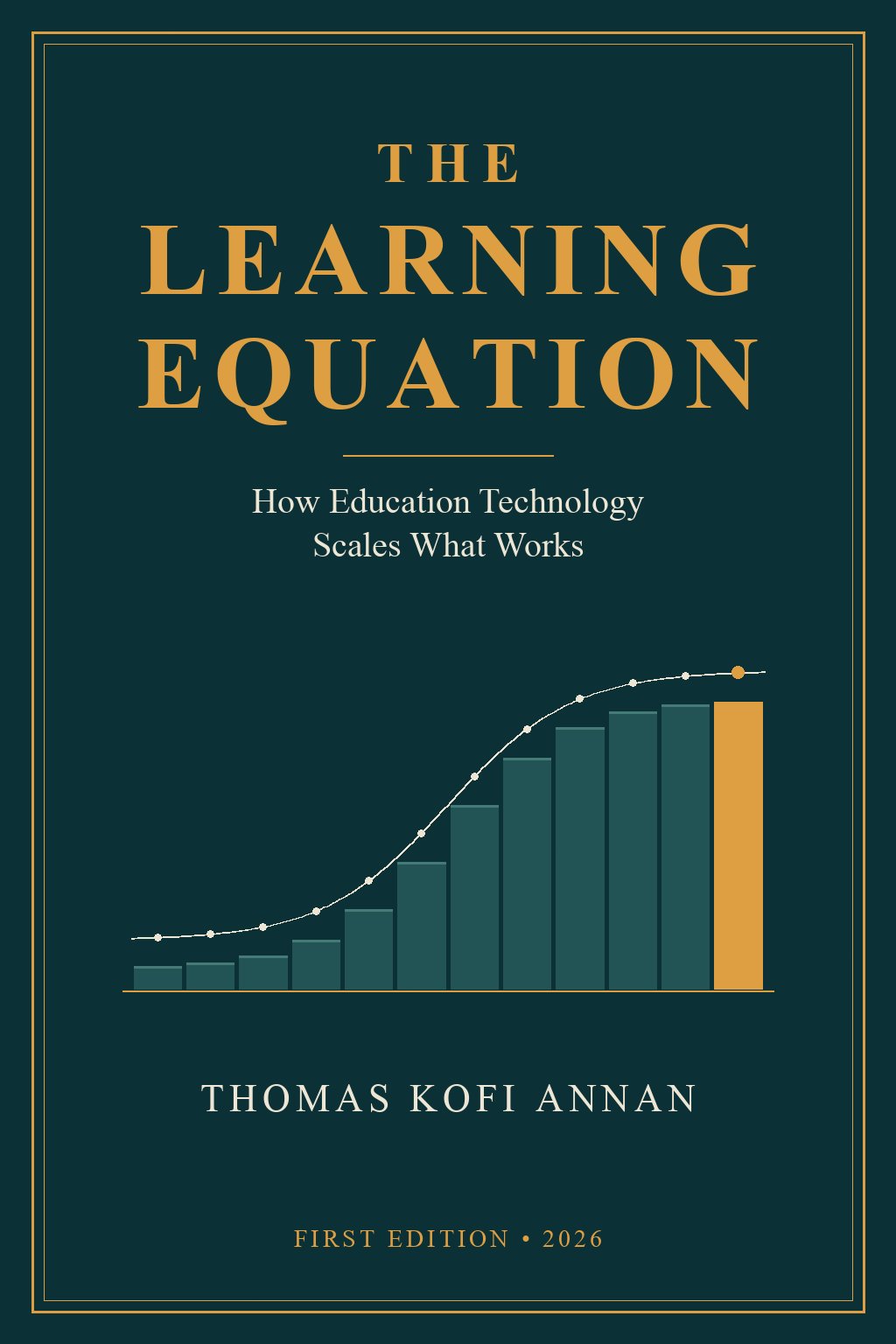
The Learning Equation cover

Education Technology · Volume 9 of the Equation Series

The Learning Equation

How Education Technology Scales What Works

By Thomas Kofi Annan · First edition, 2026

Education technology promises something unusual: to take what works for one learner with one good teacher and make it available to millions at a fraction of the cost. Sometimes it keeps that promise. Read more

25
chapters
23
industry studies
100
companies
847
moves

Complete EditionBest value

Everything above, at the best price

PDF + EPUB + M4B

$99

Buy Complete Edition

The Book

25 chapters · ~38,000 words

PDF + EPUB, plus the narrative edition

$29

Buy The Book

Research Companion

23 studies · 100 profiles · 847 moves · ~1.2 million words

PDF + EPUB, plus the narrative edition

$59

Buy Research Companion

Audiobook

135 hr 30 min across 4 volumes

M4B (chaptered)

$39

Buy Audiobook

From the preface

The learning equation

Education technology promises something unusual: to take what works for one learner with one good teacher and make it available to millions at a fraction of the cost. Sometimes it keeps that promise. A practice app keeps a learner coming back for years; a platform becomes the system a district runs on; an online degree reaches students no campus could hold. More often it does not. Products are bought and not used, used and not learned from, or learned from by the students who needed them least. Companies grow quickly on a funding wave and shrink when it ends.

The difference is rarely the technology alone. EdTech succeeds when four things line up: a learning design that actually changes what students know and can do; a buyer who is willing and able to pay, whether that is a parent, a teacher, a district, a university, an employer, or a government; a route to that buyer that costs less than the customer is worth; and evidence strong enough to survive procurement, renewal, and scrutiny. It fails when any one of these is assumed rather than earned. The user is often not the buyer, the buyer is often not the person who benefits, and the benefit often appears years after the purchase. Those gaps explain more failures than bad software does.

This book develops that view in twenty-five chapters. It begins with the structure of the education market and the economics of learning, then follows how products are designed, proven, sold, financed, and regulated across K-12, higher education, consumer learning, tutoring, and the workforce. It examines how companies grow through launches, pivots, funding rounds, acquisitions, and partnerships, and it reads selected cases for the decisions behind them. Worked examples in Appendix A make the core arithmetic explicit: subscription unit economics, district contract retention, online-program revenue sharing, and the cost-effectiveness of an intervention.

The book · ~38,000 words

Contents

Each chapter has a free preview of its opening and section list.

Education Technology Research Companion · Part I

23 industry studies

The companion opens with an in-depth study of each part of the industry, backed by 64 technical exhibits: worked examples, diligence checklists and case studies.

01K-12 Classroom Technology and Digital CurriculumThe US K-12 classroom is the largest and most politically exposed education technology market in the world. Roughly 49 million public-school students in ~13,000 districts use software chosen by teachers, curriculum directors and procurement offices, and paid for mostly with public money. Between 2020 and 2024 the market went through a once-in-a-generation shock: emergency remote learning, near-universal 1:1 devices, and ~$190B of federal ESSER relief funds, a meaningful slice of which went to software. When those funds expired, vendors that had sold "nice-to-have" supplemental tools discovered how much of their revenue had been one-time money. This section explains how classroom technology is bought and used, the difference between core and supplemental curriculum, the main product categories and their leading vendors, the ESSER boom and cliff, and how an experienced operator or investor separates durable classroom products from pandemic-era sugar highs.+ 3 exhibits02School Infrastructure: SIS, LMS and District SystemsBehind every classroom app is a layer of district software that few teachers think about and no district can run without: the student information system (SIS) that holds enrolment, attendance, schedules and grades; the learning management system (LMS) where assignments live; the rostering and single-sign-on services that connect hundreds of apps to the right students; the device-management, filtering and monitoring tools that satisfy federal law and parents; and the finance, HR, special-education and transportation systems that run the district as an organization. This layer is less exciting than classroom software but much more durable. Contracts renew at very high rates, switching takes years, and private equity has spent two decades rolling it up. The same concentration means a single breach can expose tens of millions of children, as the December 2024 PowerSchool incident showed. This section explains the systems, the interoperability standards that connect them, the economics that attract PE, and the security and safety issues that now dominate district technology agendas.+ 3 exhibits03Higher Education Technology and OPMsUniversities run on a stack of mission-critical software: a learning management system (LMS) for teaching, an ERP/student information system for records, finance and financial aid, and a CRM for recruiting and student success. These are long-lived, hard-to-replace systems sold through slow procurement, and they have produced some of EdTech's most durable businesses (and its most leveraged private-equity buyouts). Alongside the stack sits the online program manager (OPM): a company that finances, builds, markets and runs online degree programs for universities in exchange for a share of tuition, often 40–60% for 7–15 years. The OPM model drove the 2010s boom in online master's degrees, then fell apart in 2023–24 under regulatory scrutiny, rising student-acquisition costs and university backlash, ending with 2U's Chapter 11 filing. This section covers the campus stack, the OPM contract and its economics, the regulation that shaped it, and how an expert tells a durable higher-ed technology business from one that rents a university's brand.+ 3 exhibits04Online Degrees, MOOCs and Alternative CredentialsFor more than a decade, education technology has tried to answer one question: can a cheaper, faster, online credential do the economic work of a traditional degree? The answers have come in waves. MOOCs (2012) promised free elite courses for everyone and found that most enrollees never finish. Mega-universities (WGU, SNHU, ASU Online) showed that online degrees can scale to well over 100,000 students each. Competency-based education unhooked credit from seat time. Coding bootcamps and income-share agreements promised job outcomes and ran into regulators. Industry certificates (Google, IBM, AWS) and skills-based hiring promised to make the degree optional, and have changed hiring less than promised. This section covers the mechanics and economics of each, the numbers that matter, and how an expert judges whether a credential is worth anything.+ 3 exhibits05Consumer Learning & Language AppsConsumer learning is the part of EdTech where the learner, or a parent, pays directly, usually through a phone. There is no district procurement cycle and no accreditor. The product has to win attention against games, video and social media every day, and the business has to convert a small fraction of free users into subscribers who renew. Language learning is the largest and most proven category, and Duolingo is its reference company: in Q2 2026 it reported ~58.7M daily active users, ~140.6M monthly active users and ~12.7M paid subscribers. This section covers how freemium subscription learning works, the economics imposed by app stores, the main categories (language apps, "learn anything" subscriptions, creator marketplaces, edutainment), the landmark companies, and how an experienced operator or investor judges whether a consumer learning business will last.+ 2 exhibits06Tutoring, Test Prep & Homework HelpTutoring is the best-evidenced intervention in education and one of the hardest to turn into a scalable business. Decades of randomized trials show that frequent, structured tutoring can produce large learning gains, and after COVID-19 US districts spent billions of federal relief dollars trying to deliver it. At the same time, the consumer side of "academic help" (test prep, homework-help subscriptions, Q&A sites) was among the first EdTech markets hit by generative AI: Chegg, the category leader, lost roughly 48% of its market value in one day in May 2023 and saw revenue fall ~39% in 2025 alone. This section covers tutoring formats and their evidence, the economics of tutoring marketplaces and programs, the test-prep market, homework help, and how AI is changing all three.+ 3 exhibits07Workforce Learning and Corporate L&DEmployers are the largest buyers of adult education. US organizations spent ~$102.8B on training in 2025 (Training magazine), and global corporate learning spend is commonly estimated in the hundreds of billions. This money buys platforms (LMS and learning experience platforms), content libraries, custom programs, coaching, certifications, apprenticeships and tuition benefits. Corporate learning is a large, budget-driven B2B market with clear buyers (HR and L&D leaders) and multi-year contracts. It is also cyclical, crowded, and notoriously bad at proving its own value. This section covers how corporate L&D money is spent, the vendor categories and their economics, upskilling and apprenticeships, education as an employee benefit (Guild and Section 127), and how to measure training ROI honestly.+ 3 exhibits08Early Childhood and Family LearningEarly childhood is where learning science says the returns to investment are highest, and where the business of education technology is hardest. The learners (roughly ages 0–8) cannot choose, pay for or even read about the product. The buyer is a parent, a preschool director or a public program, and every purchase now happens against a background of public anxiety about screens. The segment includes subscription learning apps (ABCmouse, Lingokids, Homer, Kiddopia), free nonprofit and public-media apps (Khan Academy Kids, PBS KIDS), family-engagement tools that connect schools and parents (ClassDojo, Seesaw, ParentSquare, TalkingPoints), preschool and childcare management software (brightwheel, Procare), home-based pre-K programs (Waterford UPSTART), text-message parenting programs (Ready4K), and physical-digital hybrids (Lovevery, KiwiCo). This section explains how these businesses work, what the screen-time research and pediatric guidance actually say, how to sell to parents without exploiting them, and what separates durable early-learning companies from app-store churn machines.+ 3 exhibits0909: Learning Science & Instructional DesignLearning science studies how people come to know and remember things. Instructional design turns that knowledge into lessons, courses and software. For an EdTech company, the two together answer the only question that justifies the product: does using it cause people to learn more, faster, or more durably than they would have otherwise? This section covers the findings that hold up best (retrieval practice, spacing, interleaving, worked examples, cognitive load, feedback and mastery learning), Bloom's "two-sigma" claim and why it is mostly misquoted, the design models practitioners use, and how to build these findings into a product without letting engagement metrics quietly replace learning.+ 3 exhibits1010: AI in EducationArtificial intelligence has been "about to transform education" since the 1960s. Intelligent tutoring systems produced real but narrow gains over fifty years. Then, from November 2022, large language models (LLMs) put a capable, conversational, free tutor-or-cheating-machine in every student's pocket. This section covers the history of intelligent tutoring, the 2023–26 wave of LLM tutors and teacher copilots, AI grading and feedback, cheating and the limits of detection, data and privacy issues, what the evidence shows so far, and the company landscape. The supporting files work through AI-tutor inference costs and AI-detector base rates, track the main studies, and give a diligence checklist.+ 3 exhibits11Assessment, Credentialing and Academic IntegrityAssessment is how education systems decide what students know, and credentials are how that knowledge turns into a signal that colleges and employers will accept. Both have been digital for some time: state tests went online in the 2010s, the SAT went fully digital in 2024, and computer-adaptive testing is routine. Both are now under pressure from generative AI. If a chatbot can write the essay, pass the take-home exam and produce the portfolio, institutions have to rethink what an assessment proves. This section covers the assessment types and the markets around them, how adaptive testing works, the state-testing and admissions-testing businesses (College Board, ETS, ACT), the proctoring controversies of 2020–22, plagiarism and AI-writing detection, and digital badges and verifiable credentials. It also explains how an experienced operator or investor judges an assessment product.+ 2 exhibits12Content, Curriculum, Publishing and OERBefore "EdTech" existed, education's biggest commercial business was content: textbooks, workbooks and teacher guides from a handful of publishers. That business has been rebuilt twice in 15 years. First, print gave way to digital courseware and access codes. In higher education this led to inclusive access, where course materials are billed through tuition. In K-12 it led to digital core curriculum adopted district by district. Second, a public-good counter-movement grew up: open educational resources (OER) such as OpenStax, and nonprofit open curricula such as Illustrative Mathematics. Together with the high-quality instructional materials (HQIM) movement and EdReports, these changed what districts buy and how they judge it. Generative AI now adds a third pressure. Content can be produced almost for free, so value moves to curation, alignment, evidence and the platform that delivers it. This section covers how publishing and curriculum markets work, textbook pricing, inclusive access, OER, HQIM and adoption cycles, and how an expert evaluates content businesses.+ 2 exhibits13Business Models and Unit EconomicsEducation is a ~$6–7 trillion global spending category (HolonIQ estimates; verify current figure), but very little of it is spent on technology, and the people who learn are often not the people who pay. An EdTech business model is first an answer to the question "who pays, out of which budget, and why will they pay again next year?" This section maps the four payer models (B2C, B2B, B2B2C, B2G), the pricing mechanisms used within them (freemium, subscriptions, seat and site licences, per-pupil pricing, revenue share, marketplaces), and the unit economics that follow: CAC, LTV, payback, net revenue retention and gross margin. Two worked examples compute the numbers for a consumer subscription app and for a district SaaS company through the ESSER cliff.+ 3 exhibits14Go-to-Market: Selling to Schools, Districts and UniversitiesSelling to education institutions is slow, seasonal and political. Buyers are public bodies spending taxpayer and grant money under procurement law. The people who use the product (teachers, students, faculty) usually do not control the budget, and the people who control the budget answer to boards, auditors and parents. Successful EdTech companies combine two motions: bottom-up adoption by teachers and faculty who find and love a tool, and top-down sales to district and campus leaders who can fund it at scale. This section covers both motions, the K-12 budget cycle and fiscal-year timing, the funding sources (general funds, Title I, Title IV-A, ESSER and others), RFPs and cooperative purchasing, pilots, the long sales cycle (with a worked pipeline example), and how selling to universities and employers differs.+ 3 exhibits15Growth, Engagement & RetentionLearning takes repeated effort over months, and most learners stop long before they reach their goal. That makes retention the central problem of EdTech product design, whether the learner is a commuter on Duolingo, a fourth-grader on a math app assigned by a teacher, or an employee in a compliance course. This section covers how EdTech products grow (organic loops, classroom virality, paid acquisition), how they keep users (gamification, streaks, notifications, habit design), how to measure engagement and retention properly (DAU/MAU, cohort curves, growth-accounting models), and the tension at the center of the field: the mechanics that maximize engagement do not always maximize learning.+ 3 exhibits1616: Efficacy, Evidence & Impact MeasurementEvery EdTech company claims its product improves learning. Few can show it to a standard that would persuade a sceptical researcher. This section explains how education evidence is produced and judged: the US ESSA evidence tiers that districts use in procurement, the difference between randomised controlled trials and quasi-experimental and correlational designs, how to read and interpret effect sizes, why sample size and clustering decide what a study can detect, the What Works Clearinghouse and other evidence clearinghouses, third-party certifications such as Digital Promise's, and how to read vendor efficacy claims critically. The worked example computes effect sizes, confidence intervals, attrition and statistical power in Python, and simulates how "users vs non-users" comparisons manufacture effects that are not there.+ 3 exhibits17EdTech Investing & Funding CyclesEducation is a ~$6–7 trillion global spending category (HolonIQ's long-running estimate; verify the current figure), yet only a few percent of it is digital. That gap has drawn venture capital for two decades. It has also produced one of the sharpest boom-and-bust cycles in modern venture. Global EdTech venture funding went from ~$7bn in 2019 to ~$20.8bn in 2021, then fell to ~$2.4bn in 2024, about 88% below the peak (HolonIQ). This section covers who funds EdTech, how much they invested and when, why the 2020–21 boom happened and why it ended, how experienced investors underwrite an education company, and where impact investing fits.+ 3 exhibits18Exits, IPOs, M&A & Private Equity in EducationIn education the exit has usually been a sale to a private equity firm or a strategic buyer, not an IPO. The 2021 IPO and SPAC class mostly traded far below its offer prices. Meanwhile, PE firms such as Vista, Thoma Bravo, KKR, Bain Capital, Veritas and Blackstone built some of the sector's largest and most durable businesses by buying school and university software, consolidating it and holding it through cycles. This section covers EdTech IPOs and SPACs and how they performed, strategic M&A, PE take-privates and roll-ups, distressed exits and bankruptcies, and the mechanics that decide what sellers actually receive.+ 3 exhibits19Regulation, Privacy & Education PolicyEducation is one of the most regulated markets a technology company can enter. The customers are often public bodies, the users are often children, the money often comes from government, and the product affects a public good. For an EdTech company, regulation decides who can buy, what data can be collected, how a product can be marketed, whether federal student aid can flow through it, and in some countries whether the business may exist at all. This section covers US student-privacy law (FERPA, COPPA and its 2025 amendments, state laws such as SOPIPA), federal higher-education finance rules (Title IV, 90/10, gainful employment and the 2025 earnings test, incentive compensation and OPMs), accessibility law, European and UK children's data rules, China's 2021 "double reduction", India's coaching rules, and the fast-changing policy on AI in schools.+ 3 exhibits2020: History of Education TechnologyEducation technology has a hundred-year track record of confident predictions that did not come true. Each generation of machines (film, radio, teaching machines, mainframe terminals, microcomputers, the web, MOOCs, tablets, and now large language models) was announced as the end of the classroom as people knew it. Each one ended up absorbed into schooling in a narrower and slower form than its promoters expected. This section traces that history from Pressey's testing machine to generative AI. It covers the capital cycles, the business models each era produced, and the patterns that recur. Practitioners who know this history can tell a structural shift from a hype cycle.+ 2 exhibits2121: Careers, Teams & Building an EdTech CompanyAn EdTech company has a harder staffing problem than most software companies. It has to combine people who understand how learning works and how schools run with people who can build software and sell it. These groups have different vocabularies, incentives and pay expectations. The company also answers to two masters: a mission to improve learning, and investors who need growth and margin. This section covers founder archetypes, the roles specific to EdTech (learning designers, efficacy researchers, implementation specialists, education sales), compensation, building sales teams for schools and universities, the mission-versus-margin tension, and board and investor dynamics.+ 3 exhibits22Accessibility, Equity and the Digital DivideEdTech promises to widen access to good teaching, but only for learners who can get online, use the product and are served by its design. Three gaps decide who benefits. The access divide is devices and connectivity: the US "homework gap", and billions of people offline worldwide. The accessibility divide is whether students with disabilities can use the product at all; US law now sets a technical standard (WCAG 2.1 AA) for public schools and colleges. The use divide is whether disadvantaged students get creative, high-quality uses of technology or only drill and monitoring. This section covers the US connectivity programs (E-Rate, the Emergency Connectivity Fund, the Affordable Connectivity Program) and their 2024–26 reversals, the device cycle, universal design for learning (UDL), accessibility law (ADA Title II's 2024 rule and its 2026 deadline extension, Section 504 and 508, the European Accessibility Act), and designing for low-resource and offline settings. For a product team, the costs of getting this wrong include lost contracts, legal exposure and learners excluded by design.+ 2 exhibits2323: Global EdTech MarketsEducation is one of the largest sectors of every economy and one of the most local. Curricula, languages, exams, procurement rules, privacy law and above all who pays (the state, the family or the employer) differ by country. Those differences decide which EdTech business models work. This section compares the major markets: the United States, Europe, the United Kingdom, China, India, Southeast Asia, Latin America, Africa and the Middle East. It covers size (with appropriate hedges), payers, policy, landmark companies and how cross-border expansion succeeds or fails.+ 3 exhibits

Education Technology Research Companion · Part II

100 companies, 847 strategic moves

A profile of each company, followed by its defining moves year by year from 1920 to 2026: what was decided, why, how it was financed, and what happened next.

Browse all 100 →

Audiobook & narrative editions

135 hr 30 min of narration

Both volumes are rewritten as narrative editions that read straight through, in long-form prose instead of tables. The audiobook is narrated from those editions as chaptered M4B files that play in Apple Books, VLC, BookPlayer and most audiobook apps.

  • The Book18 hr 47 min
  • Companion Volume 1 - Industry Studies17 hr 22 min
  • Companion Volume 2 - Companies A to K46 hr 48 min
  • Companion Volume 3 - Companies K to Z and Timeline52 hr 32 min

Appendix C

Glossary: 37 terms

Read the full glossary →
ACV
Annual contract value: revenue per customer per year.
Adoption
A district's or state's formal selection of core instructional materials, usually for six to eight years.
ARR
Annual recurring revenue.
B2B2C
A model in which an institution distributes a product and the learner or parent pays, or the institution pays on the learner's behalf.
Bundled-services exception
2011 Department of Education guidance allowing tuition-share payments to a third party that provides a bundle of services including recruiting.
CAC
Customer acquisition cost: acquisition spend divided by new paying customers. Blended CAC divides by all new payers; paid CAC by those the spend acquired.
CAT
Computer-adaptive test, which selects each item from the student's previous answers.
COPPA
The US Children's Online Privacy Protection Act and the FTC rule implementing it.

From the blog

Read before you buy

All 9 articles →

The Learning Equation

Learn the framework from the book. Test it against the companion.

Choose an edition

More in the series