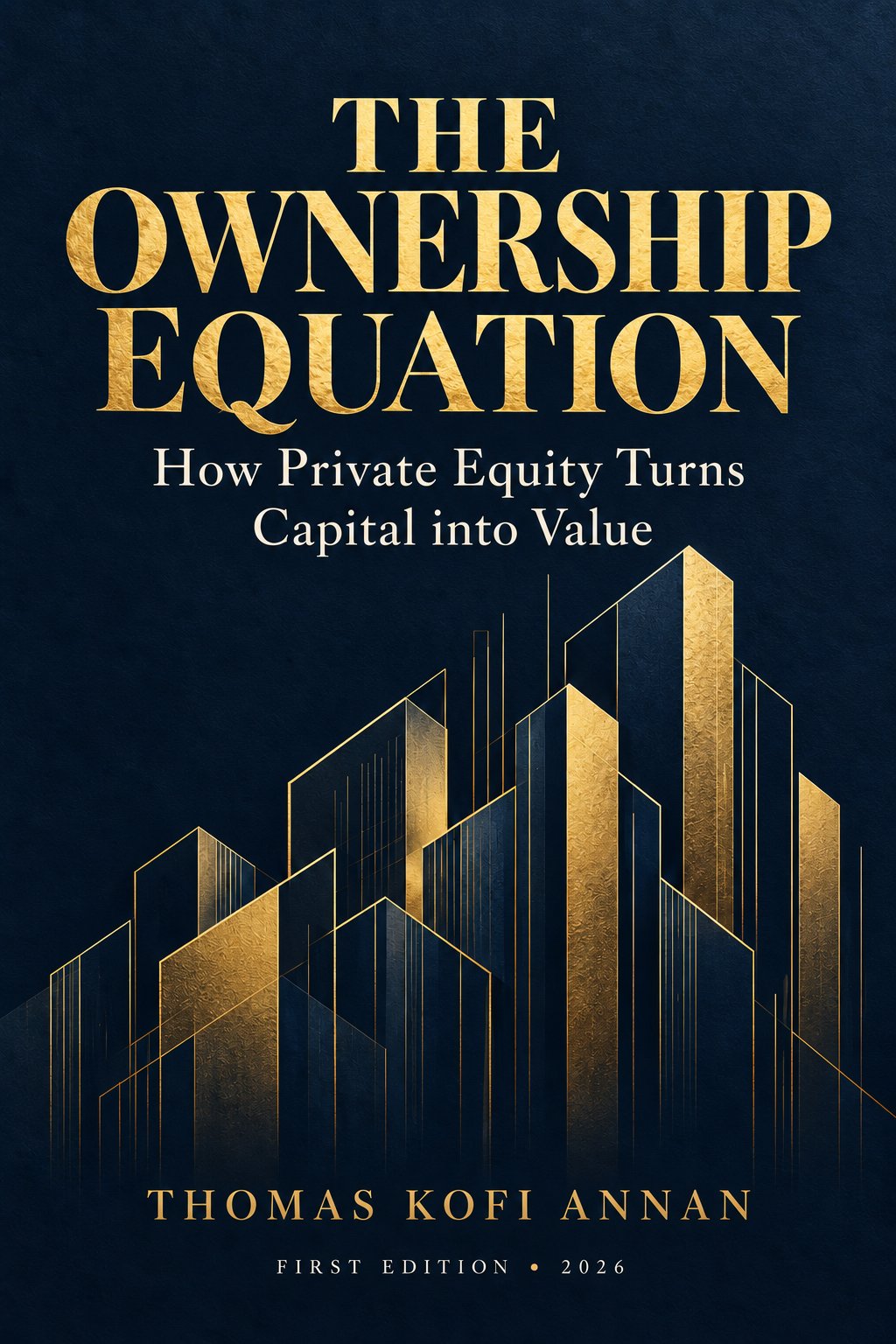
Private Equity · Volume 8 of the Equation Series
The Ownership Equation
How Private Equity Turns Capital into Value
By Thomas Kofi Annan · First edition, 2026
Private equity connects financial analysis with the responsibilities of ownership. An investment thesis must survive the purchase price, the financing, the demands of operating a business, and the eventual need to realize value. Read more
- 25
- chapters
- 22
- industry studies
- 92
- firms
- 924
- deals & moves
Complete EditionBest value
Everything above, at the best price
PDF + EPUB + M4B
$99
The Book
25 chapters · ~18,000 words
PDF + EPUB, plus the narrative edition
$29
Research Companion
22 studies · 92 profiles · 924 moves · ~1 million words
PDF + EPUB, plus the narrative edition
$59
Audiobook
149 hr 50 min across 4 volumes
M4B (chaptered)
$39
From the preface
The ownership equation
Private equity connects financial analysis with the responsibilities of ownership. An investment thesis must survive the purchase price, the financing, the demands of operating a business, and the eventual need to realize value. Studying those elements together gives the reader a stronger foundation than studying a valuation model or a famous transaction in isolation.
This book develops that foundation in twenty-five chapters. It begins with the ownership model and fund relationship, follows an investment from sourcing to exit, and then examines specialist strategies, portfolio access, governance, performance, and the investment organization. Selected cases illustrate how business economics, capital structures, and owner decisions interact. Worked examples and practical tools support the narrative.
The intended audience includes students, analysts, entrepreneurs, and readers seeking a disciplined understanding of private markets. The chapters explain concepts before applying them. The emphasis is on clear reasoning, transparent assumptions, and the connection between analysis and decisions.
The book · ~18,000 words
Contents
Each chapter has a free preview of its opening and section list.
Part I
Foundations and Fund Economics
Part II
The Investment Process
Part III
Investment Strategies and Specialist Markets
Part IV
Liquidity, Portfolio Access, and Governance
Part V
Performance and the Investment Organization
Practical Reference
Appendices
- AWorked Financial Examples
- BInvestment and Ownership Tools
- CGlossary
- DSources and the Research Companion
Private Equity Research Companion · Part I
22 industry studies
The companion opens with an in-depth study of each part of the industry, backed by 32 technical exhibits: worked examples, diligence checklists and case studies.
Private Equity Research Companion · Part II
92 firms, 924 deals and moves
A profile of each firm, followed by its defining moves year by year from 1978 to 2026: what was decided, why, how it was financed, and what happened next.
- 3G Capital11
- 3i Group plc11
- Actis8
- Advantage Partners (AP)8
- Advent International13
- Affinity Equity Partners8
- American Securities (1947 family office → private equity since 1994)8
- Apax Partners12
- Apollo Global Management, Inc.15
- Arctos Partners7
- Ardian (formerly AXA Private Equity)10
- Ares Management10
- Audax Group6
- Bain Capital13
- BC Partners12
- Berkshire Partners (1984 – present)9
- Blackstone Inc.16
- Blue Owl Capital (incl. Dyal Capital Partners / Blue Owl GP Stakes)8
- Bridgepoint (Bridgepoint Group plc)8
- Brookfield Asset Management14
- Candover (Candover Investments plc / Candover Partners) — Historical8
- Cerberus Capital Management12
- ChrysCapital8
- Cinven11
- Clayton, Dubilier & Rice (CD&R)13
- Clearlake Capital Group10
- Coller Capital (Coller EQT from 2026)8
- CVC Capital Partners12
- EQT12
- Evergreen Coast Capital (Elliott Investment Management's Private Equity Arm, now "Elliott Private Equity")8
- Forstmann Little & Co. (1978–c.2014)14
- Francisco Partners11
- General Atlantic10
- Genstar Capital8
- Golden Gate Capital8
- Golub Capital9
- GP Investments (GP Investimentos)8
- GTCR (1980 – present)9
- H.I.G. Capital7
- HarbourVest Partners8
- Helios Investment Partners8
- Hellman & Friedman (H&F)15
- Hg (formerly HgCapital)11
- Hicks, Muse, Tate & Furst (1989 – 2000s; successor HM Capital Partners)7
- Hillhouse Investment (Hillhouse Capital)8
- Hony Capital (弘毅投资)8
- IK Partners (formerly Industri Kapital / IK Investment Partners)8
- Insight Partners12
- Investcorp10
- Japan Industrial Partners (JIP)8
- Kelso & Company8
- KKR & Co. Inc. (Kohlberg Kravis Roberts)17
- Kohlberg & Company (1987 – present)7
- KPS Capital Partners9
- Leonard Green & Partners (LGP)16
- Lexington Partners7
- Lone Star Funds12
- Madison Dearborn Partners (1992 – present)10
- MBK Partners8
- New Mountain Capital8
- Nordic Capital8
- Onex Corporation11
- Pacific Equity Partners (PEP)9
- PAG (formerly Pacific Alliance Group)8
- PAI Partners11
- Partners Group10
- Patria Investments8
- Permira12
- Platinum Equity11
- Providence Equity Partners10
- Riverstone Holdings9
- Roark Capital Group11
- Searchlight Capital Partners7
- Silver Lake13
- Stone Point Capital8
- Stonepeak10
- Summit Partners8
- Sun Capital Partners9
- Sycamore Partners11
- TA Associates8
- Terra Firma Capital Partners (Guy Hands)9
- The Abraaj Group (historical, 2002–2018)8
- The Carlyle Group Inc.15
- Thoma Bravo14
- Thomas H. Lee Partners (THL)13
- TPG Inc. (formerly Texas Pacific Group)15
- Triton Partners8
- Veritas Capital12
- Vista Equity Partners13
- Warburg Pincus14
- Welsh, Carson, Anderson & Stowe (WCAS) (1979 – present)9
- Wesray Capital Corporation (1981 – early 1990s)4
Audiobook & narrative editions
149 hr 50 min of narration
Both volumes are rewritten as narrative editions that read straight through, in long-form prose instead of tables. The audiobook is narrated from those editions as chaptered M4B files that play in Apple Books, VLC, BookPlayer and most audiobook apps.
- The Book19 hr 3 min
- Companion Volume 1 - Industry Studies21 hr 48 min
- Companion Volume 2 - Firms Part One54 hr 18 min
- Companion Volume 3 - Firms Part Two and Timeline54 hr 42 min
Appendix C
Glossary: 45 terms
- Add-on acquisition
- A business acquired to join an existing portfolio platform.
- Capital call
- A request for an investor to contribute capital under the fund agreement.
- Capitalization rate
- Annual property net operating income divided by property value under the stated convention.
- Carried interest
- A contractual share of investment profits allocated to the general partner or a designated vehicle.
- Cash sweep
- A requirement or assumption that specified cash is applied to debt repayment.
- Catch-up
- A waterfall tier that reallocates distributions to bring a participant's profit share to a defined level.
- Clawback
- An obligation to return specified overpayments, commonly involving excess carried interest.
- Co-investment
- An investment alongside a lead investor in a particular transaction or asset.
From the blog
Read before you buy
Complete guide
How Private Equity Makes Money: Fees, Carry and the Buyout Engine
How private equity firms earn fees and carried interest, where buyout returns really come from, and the four factors that decide whether a deal works.
15 min read
Guide
How an LBO Works: A Step-by-Step Leveraged Buyout Example
A worked leveraged buyout example with real arithmetic: sources and uses, the debt schedule, free cash flow, exit value, MOIC and IRR, and what moves the result.
9 min read
Guide
How Private Equity Firms Value a Company: A Practitioner's Guide
How private equity firms value companies: comps, precedents, DCF and the LBO model, plus quality of earnings and the EV-to-equity bridge, with worked numbers.
8 min read
The Ownership Equation
Learn the framework from the book. Test it against the companion.
More in the series

Healthcare
The Care Equation
How Healthcare Companies Create, Capture and Destroy Value
Finance
The Money Equation
How Financial Companies Create, Capture and Destroy Value
Artificial Intelligence
The Intelligence Equation
How AI Companies Create, Capture and Destroy Value
Energy
The Power Equation
How Energy Companies Create, Capture and Destroy Value
Supply Chain
The Flow Equation
How Supply Chains Create, Capture and Destroy Value