The Equation Series
Menu

The Equation Series

The books

Each volume covers one industry: how it works, the companies that built it, and the strategy behind their defining moves. Pick an industry to see the full contents.

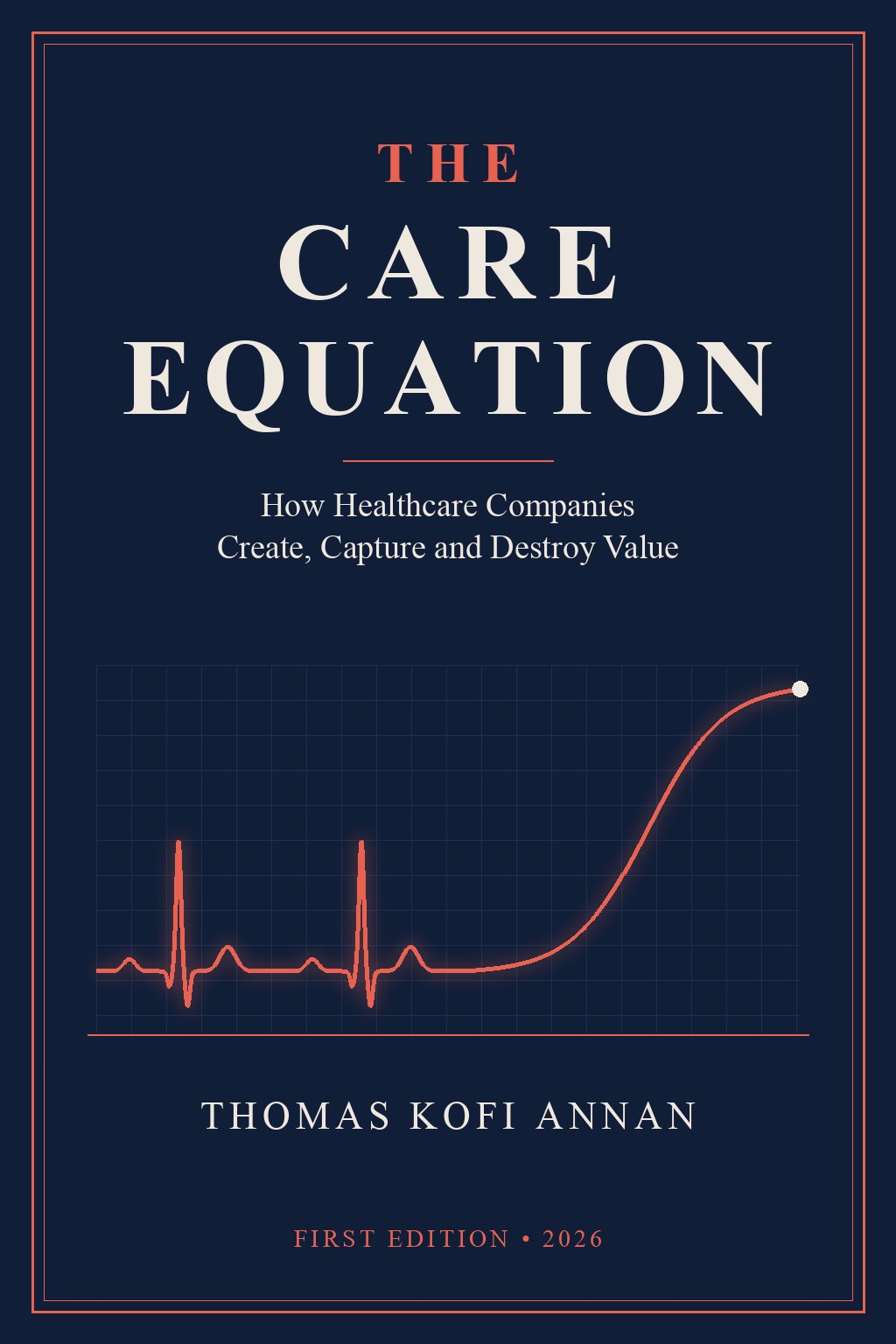
The Care Equation cover

Healthcare

The Care Equation

How Healthcare Companies Create, Capture and Destroy Value

Healthcare is the largest industry in the world and one of the hardest in which to build a business. The United States alone spent about $5.3 trillion on health in 2024, nearly a fifth of its economy. Some companies have turned that spending into lasting value: integrated systems that keep their members healthier, devices that changed how surgery and diabetes are managed, drugs that reshaped whole diseases, and, in places such as India and West Africa, models that bring care to people the system had left out. Many more have not. Well-funded start-ups have built products that clinicians would not use, programmes whose savings vanished under a randomised trial, insurers whose growth outran their underwriting, and roll-ups whose profits came from a gap in a payment formula until someone closed it. Some of the most admired companies in other industries tried to fix healthcare and left within three years.

  • 25 chapters
  • 24 industry studies
  • 100 companies
  • 881 moves
  • 1833–2026
  • 158 hr 25 min audio
The Money Equation cover

Finance

The Money Equation

How Financial Companies Create, Capture and Destroy Value

Finance is the business of other people's money, and almost everyone is its customer. A household that keeps a checking account, carries a credit card, pays a mortgage, insures a car and saves for retirement has made promises to, and accepted promises from, a dozen firms, most of which it never deals with directly. The United States has the largest and most varied financial system in the world: more than 4,200 insured banks, the deepest capital markets, the largest asset managers and insurers, the card networks that set the price of most retail payments, and a fintech industry that has tried for two decades to rebuild all of it in software. Some of these companies have created value for generations. Many more have destroyed it, and in finance destruction tends to arrive suddenly: a bank that took forty years to build failed in about 36 hours in March 2023, a market maker lost most of its capital in 45 minutes, and a crypto lender that had promised double-digit yields froze its customers' money overnight.

  • 25 chapters
  • 24 industry studies
  • 100 companies
  • 883 moves
  • 1784–2026
  • 165 hr 4 min audio
The Intelligence Equation cover

Artificial Intelligence

The Intelligence Equation

How AI Companies Create, Capture and Destroy Value

Artificial intelligence became an industry in public in four years. On 30 November 2022 OpenAI released ChatGPT as a free research preview; by early 2026 it claimed about 900 million weekly users. Nvidia, which sells most of the chips the models run on, became the first company worth $4 trillion in July 2025 and $5 trillion that October. The four largest US cloud and platform companies spent about $400 billion of capital in 2025, mostly on data centres, chips and power, and guided to more than $700 billion for 2026. AI start-ups took about half of the world's venture funding in 2025 (reported). Some of this spending has created more value for users, faster, than any technology before it. Much of it will be lost, and in AI destruction can arrive as suddenly as success: Nvidia lost about $589 billion of market value in a single day in January 2025 when a small Chinese lab showed what a cheaper model could do, a London start-up valued at ~$1.5 billion entered insolvency less than three months after its founder stepped down in 2025, and a device that had raised ~$230 million was switched off less than a year after its first reviews.

  • 25 chapters
  • 24 industry studies
  • 100 companies
  • 847 moves
  • 1984–2026
  • 152 hr 60 min audio
The Power Equation cover

Energy

The Power Equation

How Energy Companies Create, Capture and Destroy Value

In the spring of 2026 the energy industry was reminded, twice, what it sells. After US–Israeli strikes on Iran at the end of February, traffic through the Strait of Hormuz was effectively halted from early March, QatarEnergy declared force majeure on its liquefied natural gas, and Brent crude rose above $115 a barrel in March, reaching a reported high of $126.41 on 30 April. Producers whose oil could reach the sea by another route were suddenly worth more than producers with cheaper barrels and no way out. At the same time, in the United States, the grid operator for thirteen states and Washington, D.C., was paying about $329 per megawatt-day for capacity in 2026/27, against about $29 two years earlier, because technology companies building data centres needed power that could run every hour and a connection to deliver it. Owners of old nuclear plants signed twenty-year contracts with Microsoft, Amazon and Meta. Some of the industry's money in those years created more value, for more people, than almost any other business: the price of a battery pack fell by about nine-tenths between 2010 and 2025, and that of a solar module by more. Much of it was destroyed: two nuclear units in Georgia that cost about $35 billion and came in seven years late, offshore wind farms cancelled after their contracts were signed, a European battery champion that raised more than $13 billion and went bankrupt, and a week of Texas winter that left a co-operative with a power bill several times its annual revenue.

  • 25 chapters
  • 24 industry studies
  • 100 companies
  • 885 moves
  • 1836–2026
  • 159 hr 20 min audio
The Flow Equation cover

Supply Chain

The Flow Equation

How Supply Chains Create, Capture and Destroy Value

In the first months of 2026 the supply-chain business was reminded, twice, what it sells. On 20 February the Supreme Court ruled six to three, in *Learning Resources v. Trump*, that the emergency-powers law under which the United States had imposed most of its 2025 tariffs does not authorise tariffs at all. The same day the administration announced a 10% tariff on most imports under Section 122 of the Trade Act of 1974, a stopgap that ran from 24 February to 24 July and was followed by a new Section 301 regime. Importers began to claim refunds of the struck-down duties; Walmart alone reported about $2.9 billion received in one quarter. A week after the ruling, US–Israeli strikes on Iran began a war that effectively halted traffic through the Strait of Hormuz from early March. Freight rates followed: the Drewry World Container Index spot rate from Shanghai to Los Angeles was about $7,514 per forty-foot container at the end of October 2026, against about $2,290 a year earlier, and Maersk doubled the midpoint of its 2026 earnings guidance between February and August. Companies with customs expertise, inventory already on American soil or ships away from the Gulf were suddenly worth more than companies with cheaper factories.

  • 25 chapters
  • 24 industry studies
  • 100 companies
  • 848 moves
  • 1862–2026
  • 154 hr 21 min audio
The Edge Equation cover

Trading & Options

The Edge Equation

How Traders and Trading Systems Create, Capture and Destroy Value

In 2025 Americans and the firms that served them traded more listed options than in any year before. The Options Clearing Corporation cleared about 15.26 billion contracts, up 24.3% on 2024, and logged the 32 busiest days in its history. Options on the S&P 500 index that expired on the day they were traded made up a record 59% of the index's options volume for the year, and 66.2% in July 2026 (Cboe). On the other side of much of that trading sat a small number of firms. Reuters reported in April 2026, from documents and anonymous sources that the firms did not confirm, that Jane Street's net trading revenue in 2025 was about $39.6 billion, a figure that reportedly included gains from revaluing private stakes, and that Hudson River Trading and Citadel Securities had about $12 billion each. In India, whose National Stock Exchange had become the world's largest derivatives exchange by contracts traded, the securities regulator had found that 93% of 1.13 crore individual futures and options traders lost money over the three years to March 2024, about ₹1.81 lakh crore in all (SEBI, September 2024). The same contracts, at the same prices, made a few firms some of the most profitable businesses in finance and made most of the individuals who traded them poorer.

  • 25 chapters
  • 24 industry studies
  • 100 companies
  • 751 moves
  • 1892–2026
  • 17 hr 28 min audio
The Outlier Equation cover

Venture Capital

The Outlier Equation

How Venture Capital Turns Risk into Breakthroughs

Venture capital finances companies before the evidence is in. An investor commits money to a team, a product that may not yet work, and a market that may not yet exist, knowing that most such bets will fail. The asset class works only because a small number of outcomes are large enough to pay for all the rest. Understanding venture therefore means understanding how that asymmetry is created, priced, governed, and eventually turned into cash.

  • 25 chapters
  • 23 industry studies
  • 100 firms
  • 894 deals & moves
  • 1946–2025
  • 162 hr 11 min audio
The Ownership Equation cover

Private Equity

The Ownership Equation

How Private Equity Turns Capital into Value

Private equity connects financial analysis with the responsibilities of ownership. An investment thesis must survive the purchase price, the financing, the demands of operating a business, and the eventual need to realize value. Studying those elements together gives the reader a stronger foundation than studying a valuation model or a famous transaction in isolation.

  • 25 chapters
  • 22 industry studies
  • 92 firms
  • 924 deals & moves
  • 1978–2026
  • 149 hr 50 min audio
The Learning Equation cover

Education Technology

The Learning Equation

How Education Technology Scales What Works

Education technology promises something unusual: to take what works for one learner with one good teacher and make it available to millions at a fraction of the cost. Sometimes it keeps that promise. A practice app keeps a learner coming back for years; a platform becomes the system a district runs on; an online degree reaches students no campus could hold. More often it does not. Products are bought and not used, used and not learned from, or learned from by the students who needed them least. Companies grow quickly on a funding wave and shrink when it ends.

  • 25 chapters
  • 23 industry studies
  • 100 companies
  • 847 moves
  • 1920–2026
  • 135 hr 30 min audio
THEProductionEquationHow Manufacturers Create, Capture and Destroy ValueComing soon

ManufacturingComing soon

The Production Equation

How Manufacturers Create, Capture and Destroy Value

In October 2025 the Federal Aviation Administration told Boeing that it could build 42 737s a month. For the previous twenty-one months the regulator had held the company to 38, ever since a door plug blew out of a ten-week-old 737 MAX 9 on 5 January 2024 because four bolts had not been put back at the factory. Demand, a backlog of thousands and $24.25 billion of new equity could not raise its output until it had shown the FAA, with data, that it could build the aircraft right. Two months earlier, on 22 August 2025, the US government had become the largest shareholder in another manufacturer, taking about 9.9% of Intel, 433.3 million shares for about $8.9 billion, paid for largely by converting grants already promised under the CHIPS Act. Intel had broken ground for a fab complex in Ohio in 2022; by 2025 it expected the first module to operate in 2030–31, and in October 2026 a roof truss was going up on a site where about $5 billion had already been spent (reported). One manufacturer had customers, capacity and capital and was held back by its process. The other had public money, a site and a plan, and was still looking for the volume that would fill the plant.

  • 25 chapters
  • 24 industry studies
  • 100 companies
  • 844 moves
  • 1802–2026

In the works

Five more industries are planned for the series.