Private equity makes money in two layers. The firm earns a management fee (usually 1.5% to 2% a year on the capital investors commit) and carried interest (typically 20% of the fund's profits once investors have earned an 8% preferred return). The fund's investors make money when the companies the fund bought are sold for more than they cost, which happens when earnings grow, debt is repaid from cash flow, or the business sells at a higher multiple than it was bought for.
The same model can produce very different outcomes. In October 2007, at the top of the credit bubble, Blackstone closed its purchase of Hilton for about $26 billion including debt. The equity was marked down by roughly 70% in the crisis, as reported. Blackstone later reported about $14 billion of gains when it completed its exit in 2018. In the same month, KKR, TPG and Goldman Sachs closed the roughly $45 billion buyout of TXU, the Texas power company. That equity, about $8 billion, was wiped out in a 2014 bankruptcy. Both deals used the same fund structure and the same financial tools. This guide explains how the machine works and why it can give such opposite results.
What is private equity?
In the broad sense, private equity means owning shares in companies that do not trade on a public exchange. In industry usage it usually means something narrower: funds that buy established businesses, normally with control, and try to sell them for more within a few years. Chapter 1 of The Ownership Equation draws the line this way: venture capital and growth equity belong to the wider family, while private credit, infrastructure and real estate are neighboring strategies with different risks.
Three parties make up the system:
- Limited partners (LPs) supply the money. They are public pensions such as CalPERS, sovereign wealth funds, endowments such as Yale, insurers, funds of funds, and, increasingly, wealthy individuals through feeder and evergreen vehicles.
- The general partner (GP) is the private equity firm. It raises the fund, picks the investments, sits on the boards and decides when to sell.
- Portfolio companies are the businesses the fund owns.
A firm and a fund are different things. KKR is a listed company that employs people and manages many funds. Each fund is a separate legal partnership with its own investors, terms and assets. A great year for KKR's shareholders does not mean every fund investor did well, and the reverse is also true.
How does a private equity fund work?
A buyout fund is a closed-end limited partnership, usually set up in Delaware, the Cayman Islands or Luxembourg. LPs do not hand over cash on day one. They make a commitment, and the GP calls that capital as it finds deals, typically over an investment period of five to six years. The fund then sells its companies and distributes the proceeds. The standard term is 10 years with two one-year extensions, and in practice realizations often take longer.
That timing creates the well-known J-curve. In the early years investors pay fees and fund deals but receive little back, so reported returns start negative. They turn positive as companies are sold. It also explains why investors watch DPI (distributions to paid-in capital) so closely. After 2022, when exits slowed, many LPs learned that a strong paper return is not cash. The industry phrase for that period was "DPI is the new IRR."
Fundraising itself is a long sales cycle. A GP typically spends 3 to 12 months sounding out anchor investors, then launches with a placement memorandum and a draft agreement, and holds a first close 6 to 12 months later. Record funds from recent years include CVC Capital Partners IX at €26 billion (2023), reported as the largest buyout fund raised, Blackstone Capital Partners VIII at about $26 billion (2019) and Hellman & Friedman X at about $24.4 billion (2021). The fundraising and LP relations study covers the process in detail.
How do private equity firms make money?
The firm earns money from three sources: management fees, carried interest, and the return on its own commitment to the fund.
Management fees
The fee pays for the team and the office. It is charged on committed capital during the investment period, then usually steps down to a lower rate on invested capital. At scale, the fee becomes a profit center. A $20 billion flagship fund charging about 1.5% generates roughly $300 million a year before offsets. That steady income is why public markets value Blackstone, KKR, Apollo and their peers mainly on fee-related earnings and treat carry as less reliable "performance revenue."
Firms used to collect transaction and monitoring fees from portfolio companies on top. Today those are usually offset 80% to 100% against the management fee. The change followed SEC scrutiny: Blackstone settled for about $39 million in 2015, KKR for about $30 million in 2015 over broken-deal expenses, and Apollo for about $52.7 million in 2016.
Carried interest
Carry is the GP's share of the profits, and it is paid through a distribution waterfall with four tiers:
- Return of capital. Investors get back everything they contributed.
- Preferred return. Investors receive an 8% compounded annual return on that capital.
- Catch-up. The GP receives all further distributions until it holds 20% of the profit paid so far.
- Split. Everything after that is divided 80% to LPs and 20% to the GP.
A worked example in the research makes the arithmetic concrete. A $1,000 million fund that sells everything for $1,800 million after five years has $800 million of profit. The LPs receive $1,640 million and the GP $160 million, which is exactly 20% of the profit. If proceeds were only $1,500 million, the hurdle would absorb almost everything and the GP's share would fall to about 6% of profit. That is the zone where incentives change: a GP near the hurdle may hold assets longer or take more risk to get "into the carry." Chapter 3 explains why alignment has several dimensions, not just one.
Headline terms versus actual terms
| Term | Headline | Buyout market, 2024–26 |
|---|---|---|
| Management fee | 2% | 1.5–2.0% of commitments; mega-funds ~1.25–1.75% |
| Carried interest | 20% | 20% for most; 25–30% for a few premium brands |
| Preferred return | 8% | 8% compounded with a full GP catch-up |
| GP commitment | 1% | 2–5% is common |
| Fee offsets | n/a | 100% of transaction, monitoring and director fees |
| Fund term | 10 years | 10 + 1 + 1, often longer in practice |
What it all costs the investor
For a stylized $1 billion buyout fund over ten years, the research estimates lifetime management fees of about $120 million to $150 million, fund expenses of $10 million to $25 million, and carry of about $170 million on a 2.0x gross outcome. The rule of thumb that follows: a fund earning about 20% gross IRR and 2.0x to 2.5x gross typically delivers about 14% to 16% net IRR and 1.7x to 2.0x net. The gross-to-net gap is roughly 400 to 600 basis points a year.
Where do buyout returns actually come from?
The leveraged buyout is the core product. A fund buys control of a company using a slice of equity and a large amount of borrowed money, and the company's own cash flow repays that debt. Every dollar of equity gain can be traced to three sources:
- EBITDA growth, valued at the entry multiple;
- Multiple change, the difference between the entry and exit valuation multiple, applied to exit EBITDA;
- Deleveraging, the debt repaid from free cash flow during the hold.
The research's fully tied model, "Project Keystone," shows the bridge. A business with $100 million of EBITDA is bought at 11.0 times, or $1,100 million. It borrows $550 million (5.5 times EBITDA) and the sponsor puts in $577.5 million of equity, including fees. Over five years EBITDA grows to $147.2 million and free cash flow repays $240.3 million of debt. At an unchanged 11.0x exit multiple:
| Source of gain | Amount ($m) | Share |
|---|---|---|
| EBITDA growth: (147.2 − 100) × 11.0 | 519.3 | 70.9% |
| Multiple change | 0.0 | 0.0% |
| Debt paydown from cash flow | 240.3 | 32.8% |
| Transaction and financing fees | (27.5) | (3.8%) |
| Total equity gain | 732.0 | 100% |
The result is 2.27 times the money and a 17.8% IRR. Buying the same business with no debt would have produced 1.79x and 12.3%. Leverage adds about 5.5 points of IRR, and it earns them by accepting real risk: in year one, debt is 4.8 times EBITDA and interest is covered only 2.6 times. The step-by-step version of this model is in our worked LBO example.
Two points from the bridge matter for understanding the industry. First, the mix has changed over time. In the 1980s, financial engineering alone could generate 30%-plus IRRs because companies were bought at 5 to 6 times earnings. From 2010 to 2021, falling interest rates lifted valuation multiples, and multiple expansion supplied a large share of returns, as Bain & Company's annual reports documented. Since the 2022 rate reset, sponsors have had to assume flat or lower exit multiples, so the weight falls on operating improvement. Second, how the gain is attributed is a matter of convention. The same deal can be presented as 59% or 64% "operationally driven" depending on how the interaction between earnings growth and multiple change is assigned, so investors should always ask which method a GP uses.
The four factors that multiply
The preface of The Ownership Equation states that an investment thesis "must survive the purchase price, the financing, the demands of operating a business, and the eventual need to realize value." Those four tests behave like factors in a product rather than items in a sum. A brilliant operating plan cannot rescue a deal whose financing fails first, and a perfect entry price is worth nothing if the asset can never be sold. When any one factor goes to zero, so does the equity.
| Factor | The question | When it went to zero |
|---|---|---|
| Price | Did we pay a price the cash flows can justify? | RJR Nabisco, 1989: KKR won an auction at $109 a share, against a pre-bid price of about $55 to $56, and investors earned roughly break-even, as reported |
| Financing | Can the capital structure survive a bad case? | TXU / Energy Future Holdings, 2007: a leveraged bet on natural gas prices met the shale revolution |
| Operations | Can the owner actually improve the business? | Toys "R" Us, 2005: about $400 million a year of interest left too little to invest against Amazon and Walmart |
| Realization | Is there a buyer, at a price, at the right time? | 2022–25: Bain estimated about 29,000 unsold buyout companies worth about $3.6 trillion in its 2025 report |
Hilton is the counterexample. Blackstone paid a peak price, but the 2010 debt restructuring bought time (it injected about $800 million of new equity, cut debt from about $20 billion to about $16 billion and pushed maturities out to 2015), a new CEO rebuilt the operations, and an IPO in December 2013 opened the exit. All four factors stayed above zero, even though one of them, price, was poor.
How do private equity firms create value during ownership?
"Buy right, finance right, then operate" is how experienced investors put it. The operating work falls into a few groups, covered in the value creation study and Chapter 10.
Pricing is often the strongest lever because it falls straight to profit. If volume and costs hold, a 2% price increase on a business with a 20% EBITDA margin lifts EBITDA by 10%. Procurement programs typically save 2% to 8% of addressable spend, and large sponsors run group purchasing across their portfolios. Overhead work on spans, layers and shared services often takes 5% to 15% out of SG&A. Working capital improvements release cash once, often 1% to 3% of revenue.
People may matter most. Management pools typically hold 5% to 15% of the equity, and founders often roll 30% to 60% of their proceeds back into the deal. Industry surveys commonly report that around half or more of portfolio company CEOs are replaced during the hold. KKR's broad-based ownership model gave all employees at CHI Overhead Doors a stake. When the company sold to Nucor in 2022 for about $3 billion, KKR reported average payouts of about $175,000 for hourly workers.
Buy-and-build is the fourth lever. A sponsor buys a "platform" at a higher multiple and adds smaller companies at lower ones, so each acquired dollar of EBITDA is revalued upward at exit. Add-ons have made up a majority of US buyout deal count in recent years, according to PitchBook. The approach works only if the businesses are truly integrated. Otherwise the result is what practitioners call "a collection of P&Ls with a PowerPoint." Specialists such as Thoma Bravo in software have built entire franchises on a repeatable version of this playbook.
How does private equity exit an investment?
A fund only makes money when it turns ownership back into cash. The main routes are:
| Exit route | How it works | What to watch |
|---|---|---|
| Sale to a strategic buyer | A corporation buys the company, often paying for synergies | Antitrust review; fewer buyers in some sectors |
| Sale to another sponsor | Secondary buyout; roughly half of US buyout exits by count in recent years, as reported | Depends on open credit markets |
| IPO | The company lists and the fund sells down over time | Windows close, as in 2022–2024 |
| Continuation vehicle | The GP sells the asset from an old fund to a new vehicle it also manages | Built-in conflict of interest |
| Dividend recap (partial) | The company borrows to pay the owners a dividend | Raises default risk |
The last two have grown fastest. Secondary volume reached about $160 billion in 2024 (Jefferies reported about $162 billion) and more than $200 billion in 2025 by advisor estimates, with GP-led deals making up roughly 40% to 50%. Our explainers on continuation funds and dividend recapitalizations show the mechanics, and Chapter 11 compares exit routes in more depth.
How do private equity firms value a company?
A public-market analyst asks what a business is worth. A buyout professional asks a narrower question: what can I pay and still earn my required return, given the debt I can raise and the exit I can credibly expect? The answer comes from triangulating trading comparables, precedent transactions, a discounted cash flow model and, above all, an LBO model that solves for the maximum price. Diligence then tests the earnings figure being paid for. In one worked example in the research, a seller's "adjusted EBITDA" of $56.6 million fell to $43.7 million after diligence, and equity value fell 37.5%. Our guide to how private equity values companies walks through the whole process.
Beyond buyouts: the private equity family
Large firms now run many strategies under one brand. Each makes money in a different way.
| Strategy | What it buys | How it earns |
|---|---|---|
| Buyouts | Control of mature, cash-generating companies | Earnings growth, debt paydown, multiple |
| Growth equity | Minority stakes in fast-growing, often profitable firms | Revenue growth with little or no leverage |
| Venture capital | Minority stakes in young companies | A few outsized winners (power law) |
| Distressed | Debt or equity of troubled companies | Buying claims cheaply; restructuring |
| Private credit | Loans to sponsor-backed and other companies | Interest and fees |
| Infrastructure and real estate | Essential assets and property | Contracted or leased cash flows |
| Secondaries | Existing fund stakes and GP-led vehicles | Buying seasoned assets, often below NAV |
The contrast with venture capital is the most often misunderstood. Buyouts are built on avoiding losses: only 10% to 20% of deals return less than the money invested. Venture is built on finding outliers: 50% to 65% of deals may return less than 1x. Our private equity vs venture capital comparison explains why the two need opposite disciplines.
Do private equity investors actually beat the stock market?
Sometimes, and less often than marketing suggests. Top-quartile buyout funds have historically produced about 1.8x or more in net TVPI, and median funds about 1.5x to 1.7x for mature vintages, based on Cambridge Associates and Burgiss-style data. The spread between top and bottom quartile is often more than 10 percentage points of IRR. That makes manager selection the main skill for an LP.
The fair test is a public market equivalent (PME): if every dollar the fund called had gone into an index instead, and every dollar it distributed had been taken out of that index, which would have done better? A 15% net IRR in a period when the S&P 500 compounded at 15% with daily liquidity is not outperformance. The benchmark choice matters too. Buyout companies are smaller and carry more debt than the S&P 500, so a leveraged small-cap index is a tougher and arguably fairer comparison. Chapter 23 covers how to read a track record honestly.
A short history of private equity in five deals
The industry's history is a series of lessons about which factor investors forgot.
| Year | Deal | Lesson |
|---|---|---|
| 1982 | Gibson Greetings (Wesray) | Bought from RCA for about $80 million with about $1 million of equity; William Simon's roughly $330,000 stake was reportedly worth about $66 million after the IPO. It drew a flood of capital into LBOs |
| 1988–89 | RJR Nabisco (KKR) | The largest deal of its era produced some of the weakest returns of KKR's 1980s funds |
| 2007 | TXU, Hilton, Harrah's | Peak-cycle mega-deals produced the widest range of outcomes |
| 2018 | Toys "R" Us liquidation | Retail failures turned private equity into a political issue |
| 2022–25 | The DPI drought | Exits slowed, and continuation vehicles and NAV loans became standard tools |
Our list of the biggest leveraged buyout failures collects the most instructive losses in one place, and the history of private equity study traces the full arc from 1946 onward.
What are the risks of the private equity model?
The risks follow from the structure. Debt is a fixed claim and EBITDA is not. A business levered at 6 times whose EBITDA falls 30% is suddenly levered at about 8.6 times. Cyclical companies, commodity-linked companies and retailers in long-term decline make up most of the industry's failures. Floating-rate loans add interest-rate risk: a deal underwritten at 3% SOFR that faced 5.3% saw its cash interest rise by roughly 40% to 60%. Generous "adjusted EBITDA" definitions can make a deal look less levered than it is. And when sponsors pull cash out early through recaps or sale-leasebacks, the risk shifts to lenders, employees and, in healthcare, patients. Steward Health Care and Prospect Medical Holdings are the recent examples that drew the most political attention.
The takeaway
Private equity firms earn steady management fees and a share of profits, but their investors only do well when a deal passes four tests at once: a sensible price, financing that survives a bad year, real operating improvement, and an exit that turns value into cash. Leverage magnifies whichever way the business moves, which is why the same toolkit produced Hilton's roughly $14 billion gain and TXU's total loss in the same month of 2007. The best way to judge any deal is to ask which of the four factors it depends on most and what would push that factor to zero. The Ownership Equation builds that discipline chapter by chapter, starting with the ownership model in Chapter 1.
Frequently asked questions
What does 2 and 20 mean in private equity?+
It is shorthand for a 2% annual management fee and 20% carried interest on profits. In buyouts today the fee is usually 1.5% to 2% of commitments during the investment period, and large funds often charge 1.25% to 1.75%, while 20% carry above an 8% hurdle remains standard.
Do private equity firms make money if their deals lose money?+
The management company still earns management fees, so the firm can be profitable even when a fund disappoints. Carried interest, the larger prize in a good fund, is paid only after investors get their capital and preferred return back, so poor performance cuts deeply into it.
How long does a private equity firm own a company?+
The traditional plan is three to seven years. Median buyout holding periods lengthened to about six years for exits in 2023 and 2024, as reported by Bain and PitchBook, because sales and IPOs slowed after interest rates rose.
What is the difference between gross and net returns in private equity?+
Gross returns are earned on the deals before fees and carry. Net returns are what investors actually keep. For a buyout fund the gap is typically about 4 to 6 percentage points of IRR, so a 20% gross IRR often becomes roughly 14% to 16% net.
Go deeper in The Ownership Equation
Chapters
Industry studies
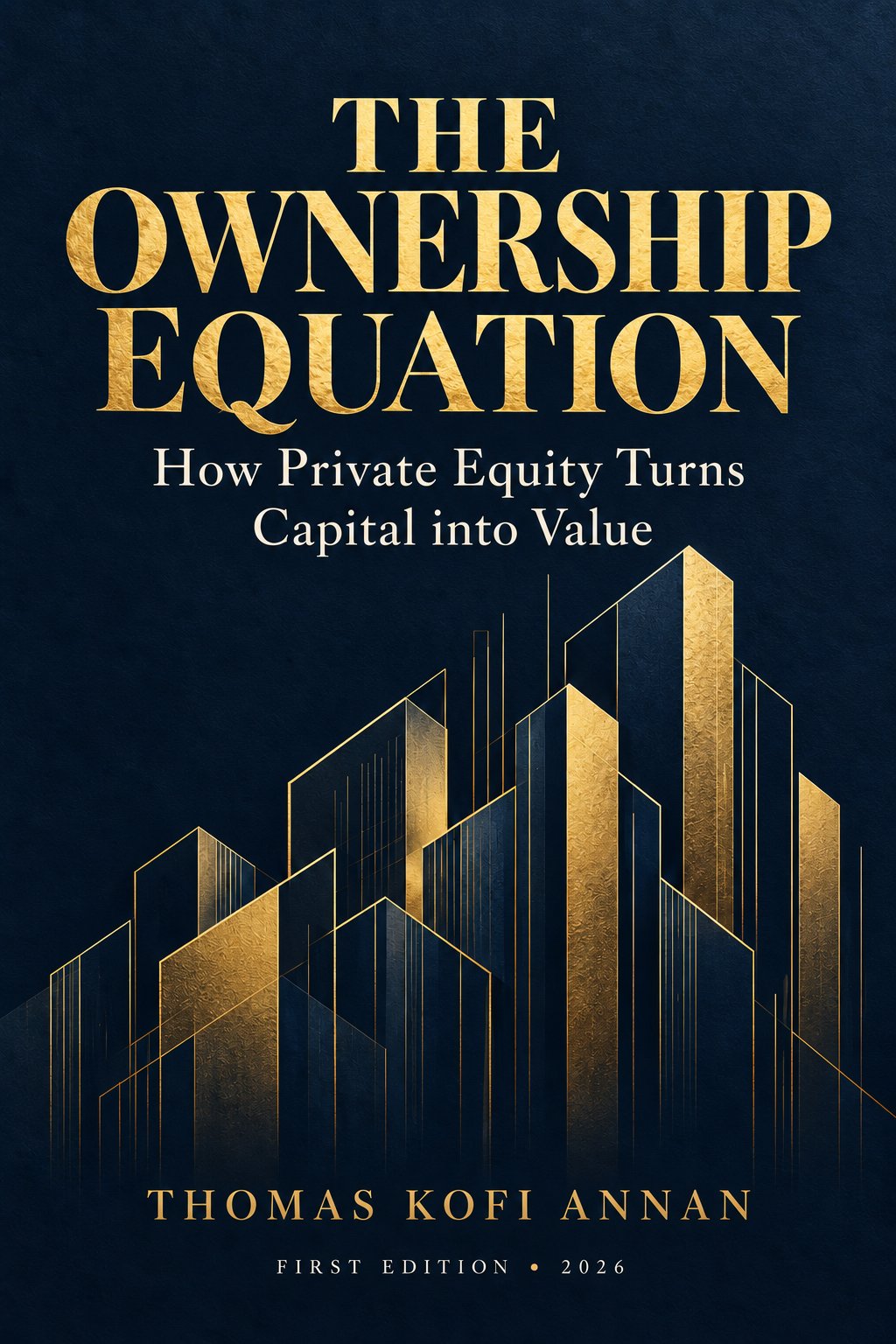
From the research behind The Ownership Equation
How Private Equity Turns Capital into Value
25 chapters, 22 industry studies, 92 firms and 924 strategic moves.
See the bookEducational content, not investment, legal, tax, medical or engineering advice. Figures marked “reported” come from filings and published sources that have not been independently audited.