The RJR Nabisco leveraged buyout was KKR's $109-a-share takeover of the tobacco and food giant, agreed in late 1988 and closed in February 1989, at about $25 billion for the equity and about $31 billion including debt, as reported. It began as a management buyout proposal by CEO F. Ross Johnson at $75 a share and became a public auction that nearly doubled the stock price. For KKR's fund investors, returns were reported as roughly break-even to low single digits a year.
The story is famous because of Barbarians at the Gate, the 1989 book by Bryan Burrough and John Helyar: the corporate jet fleet, the egos, the bidding war. The business lesson is less colorful and more useful. RJR Nabisco was a good business bought at a price that left no room for error, financed with securities that turned a market downturn into a solvency threat. It is the clearest example in the industry's history of the price factor going to zero.
What was RJR Nabisco?
RJR Nabisco was formed by the 1985 merger of R.J. Reynolds Tobacco and Nabisco Brands. It owned Winston, Salem and Camel cigarettes on one side and Oreo, Ritz, Planters and Del Monte on the other. Tobacco produced enormous, steady cash flow. The stock still traded at a low price-to-earnings ratio of about 9 times, held down by litigation fears and falling US smoking rates.
Johnson was frustrated by the share price, which sat around $55 to $56, and by failed bets such as Premier, a smokeless cigarette. He also ran a famously lavish company, with a corporate air fleet that became known as the "RJR Air Force," expensive sports sponsorships and a grand headquarters. To a buyout investor, that waste looked like hidden profit.
How did the RJR Nabisco bidding war unfold?
On October 20, 1988, Johnson proposed a management buyout at $75 a share, backed by Shearson Lehman Hutton. The bid put the company in play. KKR, which had earlier pitched an LBO to Johnson, entered at $90. Forstmann Little and a group led by First Boston also explored bids.
| Date | Event |
|---|---|
| Oct 20, 1988 | Johnson and Shearson propose a $75-a-share management buyout |
| Late Oct 1988 | KKR bids $90 a share |
| Nov 1988 | Several rounds of bidding before a special committee of the board |
| Nov 30, 1988 | KKR declared the winner at $109 a share against management's headline ~$112 |
| Feb 1989 | Deal closes |
The committee chose the lower headline bid. Its reasons, as reported, were that KKR's package had firmer financing and better securities, kept the business more intact, left a larger stake for public shareholders and treated employees better. The committee was also put off by the management agreement Johnson had negotiated, which revealed how much the management group stood to gain personally. Johnson left with a golden parachute reported at more than $50 million.
KKR had its own reasons to push hard. The deal was the biggest of its era, and KKR's reputation as the leader of the buyout industry depended on not losing it to a Wall Street bank. That pressure is part of the lesson.
How was the deal financed?
The $109 price was not all cash. It was roughly $81 of cash per share, plus PIK (pay-in-kind) preferred stock and convertible debentures. The financing stack, as reported, looked like this:
| Layer | Approximate size | Notes |
|---|---|---|
| Senior bank debt | ~$13–14 billion | Large bank syndicate |
| Bridge loans | ~$5 billion | From Drexel Burnham Lambert and Merrill Lynch, later refinanced with junk bonds and "reset" securities |
| KKR equity | ~$1.5 billion | From KKR's 1987 fund, roughly 6% of total capitalization |
Equity of about 6% is almost unimaginable today, when buyout equity typically makes up 45% to 55% of the capital. Fees across all the advisers and banks were reported at about $1 billion, with KKR's own transaction fee at about $75 million.
The most dangerous piece was the reset notes. Their interest rate had to be reset so the notes traded at face value. In a calm market that is a technicality. In a collapsing junk-bond market, it means the coupon rises to whatever level investors demand, at exactly the moment the company can least afford it. Chapter 8 of The Ownership Equation explains why the terms of debt matter as much as the amount.
What was the investment thesis?
The plan, as the research reconstructs it, had four parts:
- Tobacco as a cash machine. Reynolds' free cash flow would service the debt.
- Cutting corporate waste. The jets, the sponsorships and the headquarters signaled large savings.
- Asset sales. Parts of Nabisco, including Del Monte and international food units, could be sold to strategic buyers at high multiples to repay the bridge loans.
- New management. KKR recruited Louis V. Gerstner Jr. from American Express as CEO in 1989 to run the company on cash discipline. He left for IBM in 1993.
None of this was unreasonable. Divestitures were reported at roughly $5 billion to $6 billion in 1989–90, and cost cuts happened. The problem was that the thesis had to pay for a price that had risen from $75 to $109 in six weeks.
What went wrong after the buyout?
Three things hit the deal in sequence.
The financing nearly failed. The junk-bond market collapsed in 1989–90, and Drexel Burnham Lambert filed for bankruptcy on February 13, 1990. The reset notes threatened to reset at punitive rates. KKR led a 1990 recapitalization that put in about $1.7 billion of additional equity, as reported, to refinance the notes and avoid default. That second check was larger than the first.
Tobacco was repriced. On April 2, 1993, "Marlboro Friday," Philip Morris cut Marlboro prices by about 20% to fight discount brands. Industry profits and tobacco valuations fell sharply. Litigation risk escalated in the mid-1990s. A business assumed to be defensive turned out to have a sudden downside.
The exit was weak. KKR floated part of the company in 1991, and the stock traded poorly. In 1995 KKR exchanged its remaining RJR shares as payment in its acquisition of Borden, which itself performed badly. RJR Nabisco later split into R.J. Reynolds Tobacco and Nabisco Holdings in 1999.
Did KKR make money on RJR Nabisco?
Not for its investors in any meaningful sense. Returns to KKR's fund investors were reported as roughly break-even to low single digits a year. Some calculations put the IRR below 1% once Borden is included. The research rates its confidence in the exact return figures as medium-low, so the honest summary is "close to nothing." KKR itself earned substantial fees.
The selling shareholders were the winners. They gained a premium of about $13 billion over the pre-bid price. That is the standard result of an auction: the most optimistic bidder wins and pays away most of the value to the seller. Buyout investors call it the winner's curse.
The four factors: where RJR broke
The Ownership Equation treats a deal as four factors that multiply: price, financing, operations and realization.
| Factor | RJR Nabisco |
|---|---|
| Price | Near zero. Bidding pushed the price from $75 to $109, leaving no margin of safety |
| Financing | Fragile. About 6% equity and reset notes turned a market crash into a near-default |
| Operations | Positive. Cost cuts and asset sales happened; tobacco kept generating cash |
| Realization | Weak. A poorly received 1991 float and a 1995 exchange into a struggling Borden |
The operating story was not the problem. The deal failed because the price consumed the value the operations created, and the financing nearly ended the game before the operations could pay off. Compare that with Blackstone's Hilton buyout in 2007, which also paid a peak price but had a capital structure that could be extended. Our guide to how private equity makes money sets the two side by side.
What lessons does RJR Nabisco teach?
Winning an auction is not winning the deal. Ego and the defense of a franchise pushed the price far above the original range. In a competitive process the winner is usually the most optimistic bidder. Chapter 5 covers competition and discipline in a sale process, and the deal sourcing and process study shows how modern auctions are run.
Exotic securities can be time bombs. Securities whose terms depend on market conditions transfer market risk straight into the capital structure. The same pattern reappeared in the payment-in-kind toggle notes of 2006–07, which feature in our list of the biggest leveraged buyout failures.
Defensive industries can be repriced overnight. Marlboro Friday showed that strong cash flow is not the same as safe cash flow.
Scale is not a source of returns. The largest deal of the 1980s produced among the weakest returns of KKR's funds from that decade. KKR spent most of the following years doing smaller deals and rebuilding its reputation. TXU in 2007 would repeat the pattern at a larger size; see our TXU case study.
Optics last for decades. Barbarians at the Gate and the 1993 HBO film made the LBO a symbol of excess. The industry still lives with that framing in politics, as the history of private equity study traces.
How does RJR Nabisco compare with today's buyouts?
The structure would not be possible now. Equity contributions in large buyouts rose from about 5% to 20% in the 1980s to about 45% to 55% in 2023–25. Debt of 8 to 10 times EBITDA in the 1980s has given way to about 5 to 6 times. Reset notes have disappeared. RJR Nabisco held the record as the largest LBO in nominal terms until the 2006–07 mega-deals.
The auction dynamics have not changed. Sponsors with record amounts of uninvested capital still compete for large assets, and the leveraged buyouts study still lists the winner's curse among the top risks. The paper-LBO discipline in our worked LBO example exists to answer the question RJR's bidders stopped asking: at this price, what has to go right?
The takeaway
RJR Nabisco was not a bad business. It was a good business bought in an auction at a price that transferred most of the value to the sellers, financed with about 6% equity and reset notes that nearly broke when the junk-bond market did. Operations improved, but the price factor was close to zero, so the product was close to zero: investors earned roughly break-even. The lesson for any buyer is that the price is the one assumption you fix forever on the day you sign. Chapter 7 of The Ownership Equation covers valuation and purchase-price discipline in full.
Frequently asked questions
How much did KKR pay for RJR Nabisco?+
KKR won with a bid of $109 a share, about $25 billion for the equity and about $31 billion including assumed debt, as reported. The price was a mix of roughly $81 in cash plus PIK preferred stock and convertible debentures.
Who lost the RJR Nabisco bidding war?+
The management group led by CEO F. Ross Johnson and backed by Shearson Lehman Hutton lost, even though its final headline bid of about $112 was higher. The special committee judged KKR's financing firmer and was put off by Johnson's lavish management agreement.
Did KKR make money on RJR Nabisco?+
KKR earned large fees, but returns to its fund investors were reported as roughly break-even to low single digits a year. Some accounts put the IRR below 1% once the 1995 exchange into Borden is included.
What does Barbarians at the Gate refer to?+
It is the 1989 book by Bryan Burrough and John Helyar about the RJR Nabisco takeover battle, later made into a 1993 HBO film. It made the leveraged buyout a symbol of 1980s excess.
Go deeper in The Ownership Equation
Chapters
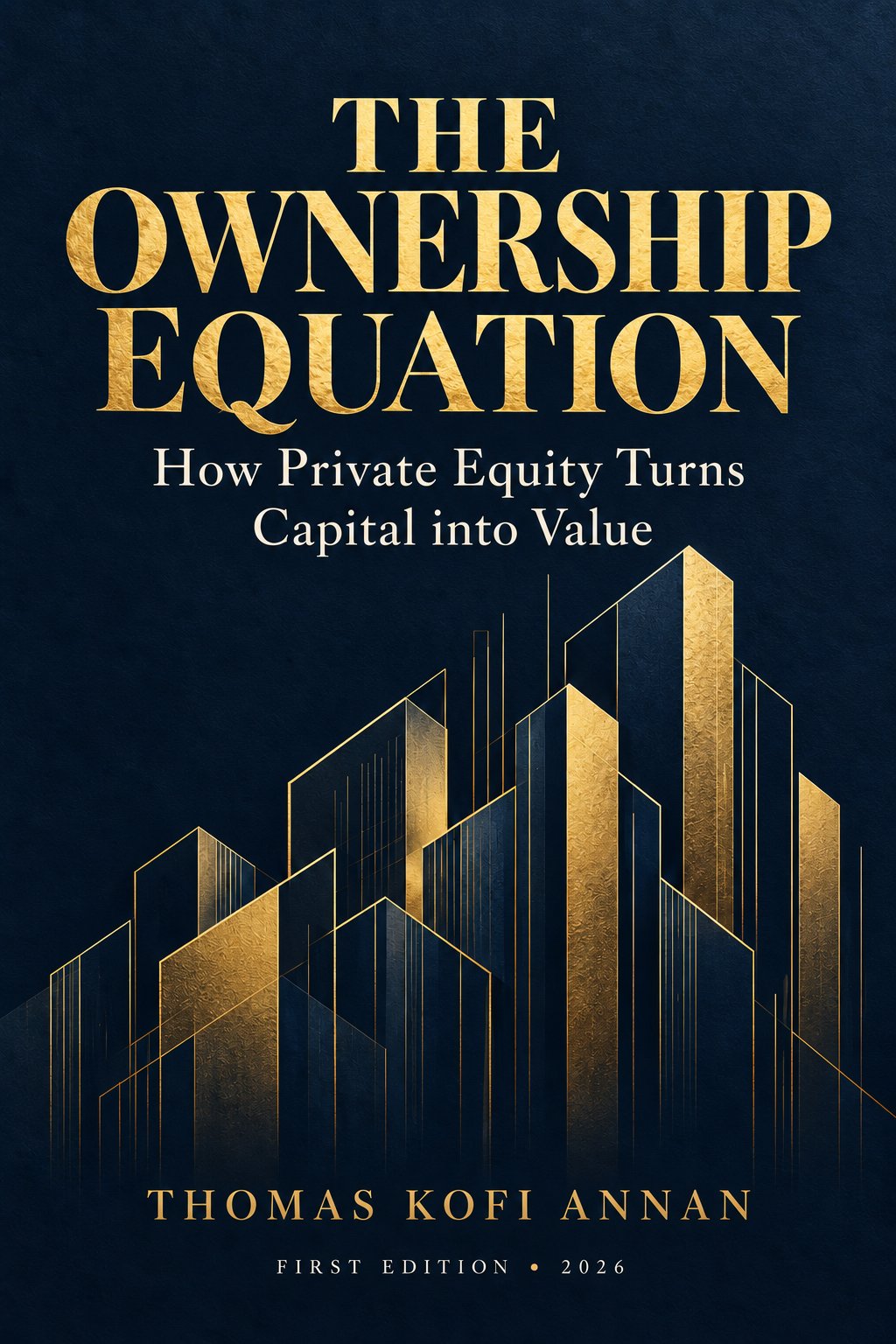
From the research behind The Ownership Equation
How Private Equity Turns Capital into Value
25 chapters, 22 industry studies, 92 firms and 924 strategic moves.
See the bookEducational content, not investment, legal, tax, medical or engineering advice. Figures marked “reported” come from filings and published sources that have not been independently audited.