The TXU leveraged buyout was the roughly $45 billion takeover of Texas's dominant power company by KKR, TPG and Goldman Sachs Capital Partners, announced in February 2007 and closed that October. Renamed Energy Future Holdings (EFH), it filed for Chapter 11 in April 2014 with more than $40 billion of debt, and the sponsors lost essentially all of their roughly $8.3 billion of equity. The cause was simple: the deal was a leveraged bet that natural gas prices would stay high, and the shale revolution made them fall.
For about two decades TXU held the record as the largest LBO ever. It is now the industry's standard example of what happens when leverage is applied to a price nobody controls. Warren Buffett, whose Berkshire Hathaway had bought about $2 billion of the company's bonds, called that purchase a "major unforced error."
What was TXU?
TXU was a Dallas-based utility holding company in ERCOT, the deregulated Texas power market. It had three businesses:
- Luminant, a large generation fleet heavy in lignite coal and nuclear power, including the Comanche Peak plant;
- TXU Energy, a retail electricity supplier;
- Oncor, the regulated transmission and distribution network.
The key fact was how ERCOT prices are set. Natural gas plants usually set the marginal price of power. Coal and nuclear plants have low running costs. So when gas traded at about $7 to $8 per MMBtu in 2006–07, Luminant's plants earned very wide margins, known as spark spreads. The power markets study in our energy book explains that pricing mechanism in detail.
TXU's CEO, John Wilder, had also announced a plan to build 11 new coal plants. Environmental groups and Texas cities fought it, the stock fell, and that created the opening for a buyout.
What was the TXU buyout deal?
| Item | Detail |
|---|---|
| Sponsors | KKR, TPG, Goldman Sachs Capital Partners; co-investors included Lehman, Citigroup and Morgan Stanley affiliates |
| Announced / closed | Feb 26, 2007 / Oct 10, 2007 |
| Price | $69.25 a share; about $32 billion equity value, about $45 billion including debt |
| Equity | About $8.3 billion, roughly 18% of the capital |
| Debt after closing | About $37 billion to $40 billion; leverage reported at about 8 to 9 times EBITDA at the holding company |
| Main new debt | $24 billion-plus of senior secured term loans at the generation company (TCEH), $11 billion-plus of unsecured and PIK-toggle notes |
The sponsors also did something novel. Before announcing, they negotiated with the Environmental Defense Fund and the Natural Resources Defense Council and agreed to cancel 8 of the 11 planned coal plants. The deal won public support and the label "the green buyout." They pledged residential price cuts of about 10%.
What was the investment thesis?
The thesis had four parts:
- High gas prices. Low-cost coal and nuclear plants would keep earning wide margins as long as gas set the power price.
- Stable regulated cash from Oncor would support the debt.
- Political de-risking through the coal-plant agreement.
- Operating improvements in plant availability, retail service and cost.
The sponsors knew the gas price was the central risk. They hedged a large share of expected generation with natural gas swaps covering roughly 2008 to 2014. That protected cash flow in the early years. But the capital structure ran for a decade, and the hedges covered about five years. At its core the equity was a long position in natural gas, financed at about 8 to 9 times EBITDA.
Why did Energy Future Holdings fail?
Shale gas changed the price permanently
Horizontal drilling and hydraulic fracturing unlocked vast US gas supply. Henry Hub prices fell from about $13 per MMBtu at the mid-2008 peak to about $2 to $4 for much of 2009–2015. ERCOT power prices fell with them. As the hedges rolled off, Luminant's margins collapsed.
The research makes a distinction worth keeping: the sponsors' downside cases reportedly assumed gas within historical ranges. Shale was not volatility. It was a regime change, and leverage turned that forecasting error into a total loss.
Extend and pretend bought time, not solvency
From 2009 to 2013, EFH ran repeated debt exchanges and amend-and-extend deals, pushing maturities out and buying back debt at a discount. These moves delayed the reckoning without fixing it. Debt of more than $40 billion could not be serviced from earnings that depended on a gas price that was not coming back.
Chapter 11 and the fight over Oncor
EFH filed for Chapter 11 in Delaware on April 29, 2014, one of the largest non-financial bankruptcies in US history. The case lasted almost four years, with long fights between creditors of the generation business (TCEH) and creditors of the holding company that owned Oncor (EFIH).
| Year | Event |
|---|---|
| 2007 | Buyout closes at about $45 billion |
| 2008 | Henry Hub gas peaks near $13; begins long decline |
| 2009–13 | Debt exchanges and amend-and-extend transactions |
| Apr 2014 | Chapter 11 filing with $40 billion-plus of debt |
| Oct 2016 | Generation business emerges as Vistra Energy, owned by former first-lien creditors |
| 2017 | Texas regulators reject NextEra's bid for Oncor over ring-fencing |
| Mar 2018 | Sempra closes its purchase of EFH's ~80% Oncor stake (about $9.45 billion of equity, ~$18.8 billion enterprise value, as reported) |
The generation business emerged in October 2016 as Vistra Energy, owned by its former first-lien creditors. The research reports that Apollo, Brookfield and Oaktree were among the holders. Distressed investors who bought the right claims ended up owning a large Texas power company, a dynamic the distressed and special situations study explains.
Why did Oncor survive?
Oncor was ring-fenced: it had a separate board and independent governance, and in 2008 a minority stake of about 20% was sold to outside investors for about $1.25 billion. The ring-fence kept Oncor's assets and customers insulated from the holding company's debts. That is why the utility retained its value and why EFIH creditors recovered so much. It is a lesson in how regulated infrastructure should be structured inside a leveraged group, a theme Chapter 16 develops.
The four factors: where TXU broke
The Ownership Equation describes four factors that multiply: price, financing, operations and realization. TXU shows what happens when the financing factor is tied to a variable outside the owner's control.
| Factor | TXU / EFH |
|---|---|
| Price | High, on peak-cycle gas assumptions |
| Financing | Zero once gas fell. 8 to 9 times EBITDA against a commodity margin, with five-year hedges on a ten-year structure |
| Operations | Largely irrelevant to the outcome. Plant availability could not offset a structural price fall |
| Realization | None for equity. Value went to creditors and, via Oncor, to Sempra |
Compare Blackstone's Hilton buyout, closed the same month. Hilton also suffered a collapse in its revenue in 2009. But hotel demand recovered, Hilton's brands held up and its lenders agreed to extend. At TXU the economics of merchant generation changed for good. Our guide to how private equity makes money sets the two deals side by side.
What lessons does TXU teach?
Never lever a commodity bet. A thesis that depends on one price you cannot control is speculation, not private equity. Leverage turns a wrong forecast into a total loss. Chapter 25 of the book treats commodity exposure as one of six recurring issues in case analysis.
Hedges buy time, not solvency. Five years of hedges could not protect a ten-year capital structure.
Model regime change, not just volatility. Technology can reset a commodity's price level quickly. Downside cases built on historical ranges will miss it.
Ring-fencing works. Oncor's protection preserved value for creditors and customers.
Fund size can drive deal selection. The mega-funds of 2006–07 needed mega-deals to put their capital to work. Scale and prestige increase blind spots. The same lesson appears in the RJR Nabisco buyout two decades earlier.
Who else lost money on TXU?
Losses reached well beyond the sponsors. TXU also shows how the risk in a leveraged buyout is distributed: equity is first in line for losses, then unsecured and holding-company debt, then secured lenders. Reported investor losses across equity and junior debt ran into the tens of billions. Berkshire Hathaway had bought about $2 billion of TXU bonds and reported a pre-tax loss of about $873 million. In his letters to Berkshire shareholders, Buffett called the purchase a "major unforced error." An investor famous for caution had misjudged how far the gas price could fall. Berkshire's broader approach is profiled in our finance book.
The takeaway
The TXU buyout failed because about $8.3 billion of equity and roughly $40 billion of debt were stacked on a single assumption, high natural gas prices, that the shale revolution overturned. Hedges covered five years of a ten-year structure, debt exchanges delayed the end, and the 2014 bankruptcy handed the generation business to creditors while ring-fenced Oncor kept its value. In the language of the four factors, the financing was tied to a variable no owner controls, so when gas fell, the product went to zero. For the full list of comparable losses, see our biggest leveraged buyout failures, and for how to stress-test a financing, read Chapter 8 of The Ownership Equation.
Frequently asked questions
Why did Energy Future Holdings go bankrupt?+
The 2007 buyout was effectively a leveraged bet that natural gas prices would stay high, which kept Texas power prices high. Shale drilling pushed gas to about $2 to $4 per MMBtu from 2009, generation margins collapsed as hedges rolled off, and the company could not service about $40 billion of debt.
How much did KKR and TPG lose on TXU?+
The sponsors and co-investors lost essentially all of their roughly $8.3 billion of equity. KKR, TPG and Goldman Sachs had written their stakes to near zero by about 2012 to 2014.
What happened to Oncor after the TXU bankruptcy?+
Oncor, the regulated transmission and distribution utility, was protected by a ring-fence and kept its value. After a NextEra bid was rejected by Texas regulators in 2017, Sempra Energy bought EFH's roughly 80% stake in 2018 for about $9.45 billion of equity, as reported.
Was TXU the largest leveraged buyout ever?+
At about $45 billion including debt, it held the record for roughly two decades. The Electronic Arts take-private announced in September 2025 by PIF, Silver Lake and Affinity Partners, at about $55 billion as reported, was described as surpassing it.
Go deeper in The Ownership Equation
Chapters
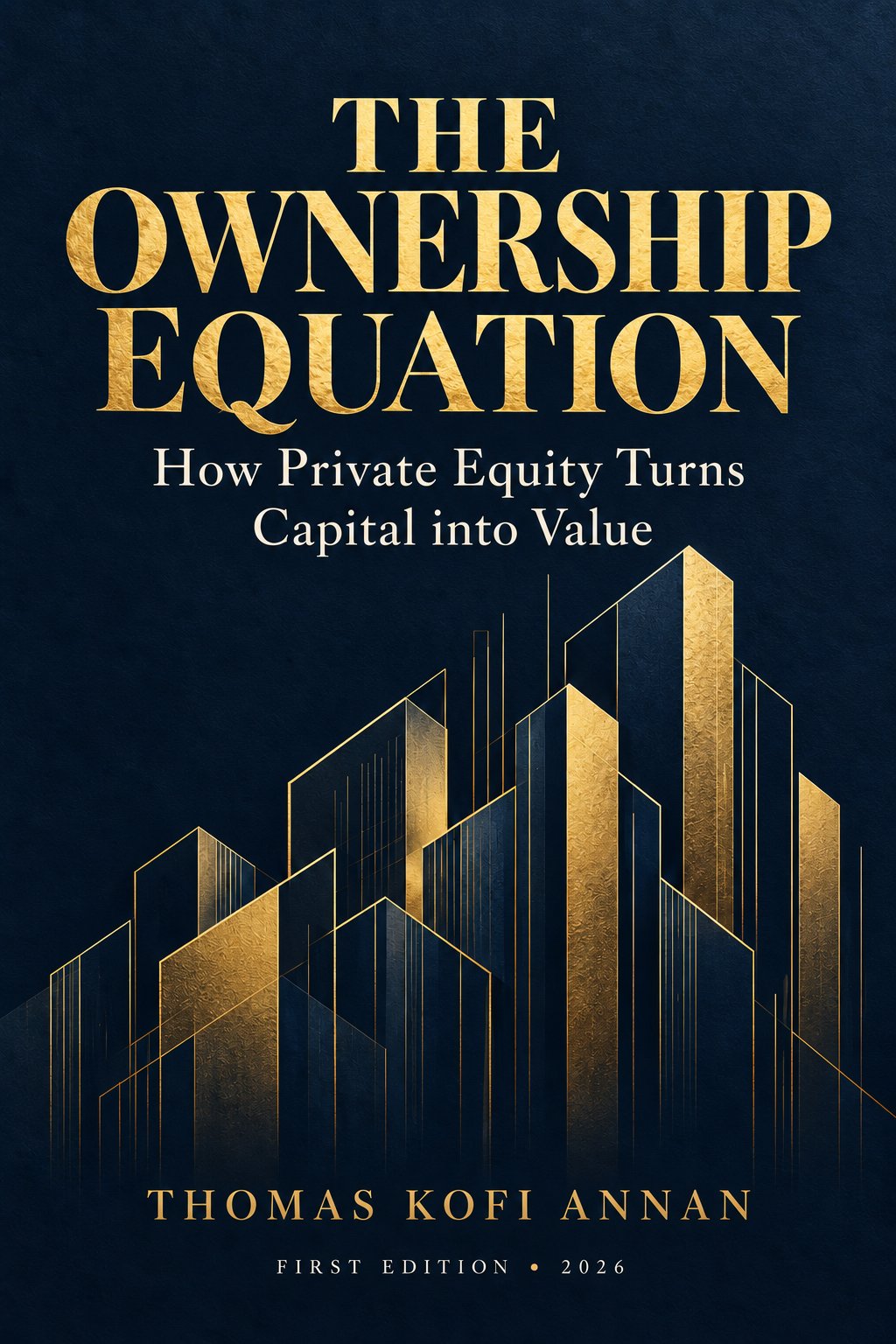
From the research behind The Ownership Equation
How Private Equity Turns Capital into Value
25 chapters, 22 industry studies, 92 firms and 924 strategic moves.
See the bookEducational content, not investment, legal, tax, medical or engineering advice. Figures marked “reported” come from filings and published sources that have not been independently audited.